


Resting Metabolic Rate and Body Composition: What Your DEXA Scan Reveals About How Many Calories You Actually Burn
Most people who want to lose weight, gain muscle, or simply understand their health start with the same question: how many calories do I actually burn each day? The answer depends almost entirely on your resting metabolic rate, the energy your body uses just to keep you alive while you do nothing at all.
The problem is that most calorie calculators estimate your resting metabolic rate using your weight, height, age, and sex. They cannot see what is happening underneath: how much of your body is metabolically active lean tissue and how much is relatively inert fat. Two people who weigh the same can burn vastly different amounts of energy at rest, and only a body composition measurement can explain why.
Quick answer: Your resting metabolic rate (RMR) accounts for 60 to 75 per cent of your total daily calorie expenditure. Fat-free mass is the single strongest predictor of RMR, contributing roughly 20.5 kilocalories per kilogram per day. A body composition DEXA scan measures your lean mass and fat mass with clinical precision, giving you the data you need to calculate a genuinely personalised metabolic rate rather than relying on population-average guesswork.
What Is Resting Metabolic Rate and Why Does It Matter?
Resting metabolic rate is the number of calories your body burns to maintain basic life-sustaining functions: breathing, circulating blood, repairing cells, regulating temperature, and keeping your brain active. It does not include calories burned through physical activity, digestion, or movement throughout the day.
For most adults, RMR accounts for between 60 and 75 per cent of total daily energy expenditure. That means the majority of the calories you burn each day have nothing to do with exercise. They are consumed by your organs, your muscles, and the biological machinery that keeps you functioning while you sit, sleep, or stand still.
Understanding your RMR matters because it forms the foundation of any evidence-based nutrition plan. If you overestimate it, you will eat more than you need and gain fat. If you underestimate it, you risk losing muscle alongside fat, which further lowers your metabolic rate and creates the frustrating cycle of weight regain that so many people experience. Research published in the European Journal of Clinical Nutrition confirms that fat-free mass (FFM) is the strongest single predictor of RMR, with a correlation coefficient of approximately 0.82, ahead of both total body weight and height.
How Lean Mass Drives Your Metabolic Rate
Not all body tissue burns energy at the same rate. Skeletal muscle, organs, and bone are metabolically active: they require a constant supply of oxygen and fuel even when you are completely at rest. Fat tissue, by contrast, is relatively metabolically quiet. It stores energy rather than consuming it.
Peer-reviewed research shows that each kilogram of fat-free mass contributes roughly 20.5 kilocalories per day to your resting energy expenditure, while each kilogram of fat mass contributes only about 7.7 kilocalories per day. That nearly threefold difference explains why two individuals who weigh 80 kilograms can have resting metabolic rates that differ by 300 calories or more. The person with 60 kilograms of lean mass will burn significantly more energy at rest than the person with 50 kilograms of lean mass, even though the scale shows the same number.
This is also why losing muscle during a diet has such a disproportionate effect on metabolism. Losing five kilograms of fat reduces your daily resting expenditure by about 39 kilocalories. Losing five kilograms of lean mass reduces it by about 103 kilocalories. The metabolic penalty for muscle loss is nearly three times greater than the reduction from losing fat, which is one reason that aggressive calorie restriction without adequate protein and resistance training so often leads to metabolic slowdown and weight regain.
Why Online Calorie Calculators Get It Wrong
The most widely used RMR prediction equations, including Harris-Benedict, Mifflin-St Jeor, and the WHO/FAO formula, rely on total body weight as a primary input. They assume a roughly average ratio of lean mass to fat mass for any given weight, age, and sex. For the average person in the middle of the population bell curve, these formulas are reasonable approximations. For anyone whose body composition deviates meaningfully from the average, they can be significantly inaccurate.
A systematic review and meta-analysis published in Sports Medicine in 2023 found that common prediction equations can under- or overestimate measured RMR by 10 to 16 per cent. For someone with a true RMR of 1,600 kilocalories, that means the calculator might tell them they burn anywhere from 1,344 to 1,856 calories at rest. Over a week, that error compounds into a difference of nearly 2,000 calories, enough to stall fat loss entirely or cause unintended weight gain.
The Cunningham equation was designed to improve accuracy by using fat-free mass instead of total weight. It performs better in lean and athletic populations, but a cross-validation study in the Nutrients journal found that it can overestimate RMR by up to 16.6 per cent in the general population. No single equation works perfectly across all body types, fitness levels, and ages. The common thread in the research is clear: the more precisely you know your lean mass, the more accurately you can estimate your metabolic rate.
What a DEXA Scan Reveals About Your Metabolism
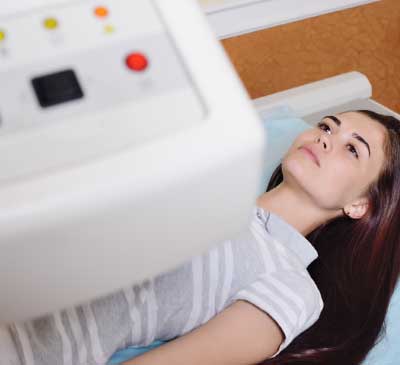
A DEXA (dual-energy X-ray absorptiometry) scan measures your body composition with clinical-grade precision. In a single seven-minute scan, it quantifies your total lean mass, fat mass, bone mineral content, and visceral adipose tissue. Crucially, it reports these values for your whole body and for individual regions: arms, legs, trunk, and the android and gynoid zones.
This regional breakdown is what makes a DEXA scan uniquely useful for understanding your metabolic rate. Your appendicular lean mass (the lean tissue in your arms and legs, which is predominantly skeletal muscle) is the component most responsive to exercise and dietary intervention. Knowing how much skeletal muscle you carry, and where you carry it, lets a clinician or nutritionist estimate your RMR with far greater accuracy than any weight-based formula allows.
A 2024 study in the Journal of Sports Sciences confirmed that RMR estimates using DEXA-derived fat-free mass showed a positive and statistically significant correlation (r = 0.89) with indirect calorimetry measurements, the clinical gold standard. In practical terms, a DEXA-informed RMR calculation gets you within roughly 5 to 8 per cent of your true metabolic rate, compared to errors of 10 to 16 per cent with weight-only formulas. For someone planning a 12-week nutrition programme, that difference can mean the difference between steady progress and a frustrating plateau.
How to Use Your DEXA Results to Optimise Your Metabolic Rate
Once you have your DEXA results, you can take several evidence-based steps to protect or increase your resting metabolic rate.
Prioritise resistance training. Skeletal muscle is the largest modifiable contributor to RMR. We explored this in detail in our guide to strength training and body composition on a DEXA scan. Even two to three sessions per week of progressive resistance exercise can preserve lean mass during a calorie deficit and, over time, add new muscle tissue that raises your baseline energy expenditure.
Eat enough protein. The current evidence suggests that adults aiming to preserve or build muscle should consume between 1.6 and 2.2 grams of protein per kilogram of body weight per day. Protein also has the highest thermic effect of any macronutrient: your body uses roughly 20 to 30 per cent of the energy from protein simply to digest and absorb it, compared to 5 to 10 per cent for carbohydrates and 0 to 3 per cent for fat.
Avoid aggressive calorie restriction. Very low calorie diets (below roughly 1,200 kilocalories for women and 1,500 for men) consistently produce disproportionate lean mass loss. Your DEXA report gives you a precise starting point: you can calculate a moderate deficit of 300 to 500 kilocalories below your DEXA-informed RMR without risking the metabolic adaptation that accompanies severe restriction.
Track changes over time. A follow-up DEXA scan after 12 to 16 weeks of training and nutrition changes shows whether you have gained lean mass, lost fat, or both. If your lean mass has increased, your RMR has almost certainly risen with it. If lean mass has declined despite fat loss, your nutrition or training plan needs adjustment before the metabolic slowdown becomes harder to reverse.
When Your Metabolic Rate Drops and What to Watch For
Several factors can cause a meaningful decline in resting metabolic rate, many of them detectable on a DEXA scan before symptoms appear.
Ageing and sarcopenia. Adults lose approximately 3 to 8 per cent of their muscle mass per decade after the age of 30, with the rate accelerating after 60. This age-related muscle loss, known as sarcopenia, is one of the primary reasons metabolic rate declines with age. A DEXA scan can detect early sarcopenia by measuring your appendicular lean mass index (ALM divided by height squared) and comparing it to validated diagnostic thresholds set by the European Working Group on Sarcopenia in Older People (EWGSOP2).
Prolonged dieting. Extended periods of calorie restriction, especially without resistance training, lead to adaptive thermogenesis: your body downregulates metabolic rate beyond what would be expected from the weight lost alone. Serial DEXA scans can reveal whether a diet is producing healthy fat loss or unhealthy lean mass depletion.
Hormonal changes. Thyroid disorders, menopause, and low testosterone all influence metabolic rate through their effects on lean mass and fat distribution. A bone density DEXA scan can simultaneously assess skeletal health in these populations, since the same hormonal changes that reduce metabolism often accelerate bone loss.
Sedentary behaviour. Physical inactivity leads to progressive muscle disuse atrophy. Even without a change in body weight, lean mass can decline and fat mass can increase, a pattern sometimes called “normal weight obesity.” Your DEXA scan can identify this shift before it shows up on the bathroom scale.
Frequently Asked Questions
What is a normal resting metabolic rate?
RMR varies widely based on body size, composition, age, and sex. For adult women, a typical range is 1,200 to 1,600 kilocalories per day. For adult men, it is usually 1,400 to 1,800 kilocalories per day. People with more lean mass will be at the higher end of these ranges.
Can a DEXA scan measure my metabolic rate directly?
No. A DEXA scan measures your body composition, specifically your lean mass, fat mass, and bone mineral content. Your resting metabolic rate can then be estimated with much greater accuracy using your DEXA-measured lean mass in validated prediction equations, rather than relying on total body weight alone.
How accurate are calorie calculators compared to a DEXA-informed estimate?
Standard weight-based calorie calculators can be off by 10 to 16 per cent. DEXA-informed RMR estimates using fat-free mass typically achieve accuracy within 5 to 8 per cent of indirect calorimetry measurements.
Will building muscle really increase my metabolic rate?
Yes. Each kilogram of muscle tissue burns roughly 13 kilocalories per day at rest, and the total metabolic contribution of fat-free mass (which includes organs, bone, and muscle) is approximately 20.5 kilocalories per kilogram per day. Gaining even 2 to 3 kilograms of lean mass through a structured resistance programme will produce a measurable increase in your resting metabolic rate.
How often should I get a DEXA scan to track metabolic changes?
For most people pursuing a fitness or weight management programme, a follow-up scan every 12 to 16 weeks provides enough time for meaningful body composition changes to occur. Your clinician can recommend a schedule based on your individual goals.
Does losing weight always reduce your metabolic rate?
Not necessarily. If you lose predominantly fat while preserving or gaining lean mass (a process known as body recomposition), your metabolic rate may stay stable or even increase. The key is adequate protein intake, resistance training, and avoiding overly aggressive calorie deficits. A DEXA scan is the most reliable way to confirm that your weight loss is coming from fat rather than muscle.
Book Your DEXA Body Composition Scan
Understanding your resting metabolic rate starts with knowing your body composition. A DEXA scan at our Harley Street clinic gives you the precise lean mass and fat mass data you need to calculate a genuinely personalised calorie target, rather than relying on generic online estimates.
Whether you are starting a new training programme, adjusting your nutrition plan, or simply want to understand why your weight is not responding the way you expected, a DEXA scan provides the clinical-grade data that transforms guesswork into an evidence-based strategy.
To book your scan or ask a question, call us on 0207 637 8227 or visit DEXA London body composition scan.
Weight management next step
If your DEXA results show that excess body fat is suppressing your metabolic rate and dietary changes alone have not been enough, a supervised weight-loss programme may help you break through the plateau. CutKilo, the sister service to DEXA London, offers doctor-led Mounjaro treatment from Dr. Emil Gadimali. Start the CutKilo questionnaire to see if you are suitable.