

Endurance Exercise and Bone Density: Why Runners, Cyclists, and Swimmers Need a DEXA Scan
You train five, six, sometimes seven days a week. Your resting heart rate sits in the low fifties. Your VO2 max would impress most cardiologists. By every conventional measure, you are fit. But if you are a runner, cyclist, or swimmer who relies almost entirely on endurance training, your bones may be telling a very different story.
A growing body of research shows that endurance athletes, particularly those in non-weight-bearing sports, are at significantly higher risk of low bone mineral density (BMD) than either sedentary adults or athletes who include impact and resistance work. A systematic review published in BMC Medicine found that 84 per cent of competitive cyclists met the diagnostic criteria for osteopenia or osteoporosis, a figure far higher than the general population of the same age.
A bone density DEXA scan is the only way to measure BMD with clinical precision. If your training is predominantly endurance-based and you have never had your bone density checked, the results may surprise you.
Quick Answer: Endurance exercise alone does not build bone density the way many athletes assume. Cycling, swimming, and even long-distance running can leave your skeleton under-stimulated. A DEXA scan at our Harley Street clinic reveals your exact bone mineral density at the hip, spine, and whole body, giving you the information you need to protect your skeletal health before a stress fracture or fragility fracture occurs.
Why Endurance Exercise Does Not Protect Your Bones
Bone is living tissue that remodels in response to mechanical loading. When you land from a jump, lift a barbell, or absorb the impact of sprinting, the force transmitted through your skeleton triggers osteoblast activity, the process by which new bone is laid down. This is known as Wolff’s law: bone adapts to the loads placed upon it.
Endurance exercise, however, often involves repetitive, low-impact movement rather than high-magnitude loading. Cycling removes ground-reaction forces entirely because your weight is supported by the saddle. Swimming is performed in a buoyant environment that unloads the skeleton almost completely. Even running, which does involve impact, becomes less osteogenic over time as the skeleton adapts to the repetitive, predictable loading pattern.
A 2012 systematic review in BMC Medicine examined 31 studies on cycling and bone health. The authors concluded that road cycling is associated with low areal bone mineral density at the hip and lumbar spine, and that the sport should be considered a risk factor for the early development of osteopenia and osteoporosis. The NHS notes that weight-bearing exercise and resistance training are the most effective forms of physical activity for building and maintaining bone density.
Cyclists Are at the Highest Risk
Among endurance athletes, cyclists consistently show the lowest bone mineral density. A study published in the British Journal of Sports Medicine found that competitive cyclists were seven times more likely to have osteopenia of the lumbar spine than age-matched runners, even after adjusting for body weight and training volume.
Several factors contribute to this. First, cycling is entirely non-weight-bearing: the saddle, handlebars, and pedals absorb your body weight rather than your skeleton. Second, competitive cyclists often train for 15 to 25 hours per week, displacing time that could be spent on bone-stimulating activities. Third, the sport encourages a lean physique, and athletes who maintain very low body fat may inadvertently reduce the mechanical load on their bones even when off the bike.
Sweat losses during long rides also contribute. Calcium is lost through sweat, and cyclists who train heavily in warm conditions without adequate calcium replacement may experience a net negative calcium balance that accelerates bone turnover. Research published in Medicine and Science in Sports and Exercise found that a single 2-hour cycling session could elevate markers of bone resorption for up to 24 hours in athletes with inadequate calcium intake.
The clinical concern is real: professional and amateur cyclists have sustained fragility fractures of the hip and spine at ages when these injuries are virtually unheard of in other athletic populations. A body composition DEXA scan can reveal whether your training habits are quietly undermining your skeletal health.
Runners, Swimmers, and Triathletes: Where Do They Stand?
Running is a weight-bearing activity, and runners generally have better bone density than cyclists or swimmers. However, the picture is not uniformly positive. Long-distance runners who maintain very high weekly mileage, restrict caloric intake, or have a history of amenorrhoea (in female athletes) can develop bone density levels below the expected range for their age.
A study in the Journal of Bone and Mineral Research found that female distance runners with menstrual irregularities had significantly lower lumbar spine BMD than eumenorrheic runners, with some meeting the diagnostic threshold for osteoporosis. The repetitive, unidirectional nature of running also means that bone density gains tend to be site-specific: the tibia and calcaneus benefit from impact loading, but the lumbar spine may not receive adequate stimulus.
Swimming, like cycling, removes gravitational loading almost entirely. A systematic review published in Revista Brasileira de Medicina do Esporte concluded that swimming and cycling do not produce positive effects on bone mineral density, and that athletes in these sports should be considered at risk of low BMD regardless of their overall fitness level.
Triathletes occupy a middle ground. The running component of triathlon provides some skeletal loading, but the cycling and swimming portions do not, and the cumulative training volume often means that triathletes spend the majority of their training hours in non-weight-bearing activities. A DEXA scan allows triathletes to see exactly how their bone density compares to age-matched reference populations.
Relative Energy Deficiency in Sport (RED-S) and Bone Health
Low bone density in endurance athletes is not always caused by the exercise itself. Relative Energy Deficiency in Sport, known as RED-S, is a syndrome that occurs when an athlete’s energy intake is insufficient to support both their training demands and normal physiological function. Bone health is one of the systems most affected.
RED-S replaces the older concept of the Female Athlete Triad (low energy availability, menstrual dysfunction, and low bone density), though it is now recognised as affecting both male and female athletes. When energy availability drops below approximately 30 kcal per kilogram of lean body mass per day, the body down-regulates bone formation and up-regulates bone resorption to conserve energy. Over months and years, this leads to measurable bone loss.
The 2025 update to the Female Athlete Triad Coalition Consensus Statement, published in Sports Medicine, expanded its clinical guidelines to include bone stress injuries as part of the bone health spectrum, alongside low BMD. This is clinically important because stress fractures in endurance athletes are often the first visible sign of underlying bone fragility that has been developing silently for years.
A DEXA scan provides the definitive measurement. If you are training heavily, maintaining a lean physique, or have experienced a stress fracture, checking your bone mineral density is a critical step in identifying RED-S before it causes irreversible skeletal damage.
What a DEXA Scan Reveals for Endurance Athletes
A DEXA (dual-energy X-ray absorptiometry) scan measures bone mineral density at the lumbar spine, femoral neck (hip), and total body. For endurance athletes, these measurements provide three distinct pieces of information that no other assessment can offer.
First, the scan produces a T-score, which compares your bone density to that of a healthy 30-year-old adult at peak bone mass. A T-score between -1.0 and -2.5 indicates osteopenia (lower-than-normal bone density), while a T-score below -2.5 indicates osteoporosis. For athletes under 50, the Z-score, which compares your density to others of the same age and sex, is often the more clinically relevant metric. You can read more about how these scores are interpreted in our guide to DEXA T-scores and Z-scores.
Second, a DEXA scan identifies site-specific weaknesses. A cyclist may have acceptable bone density at the tibia but significantly reduced density at the lumbar spine, a pattern that would not be detected by a single-site screening tool. Knowing which skeletal regions are most affected allows you and your clinician to target interventions precisely.
Third, serial DEXA scans taken over time show the trajectory of your bone health. If your BMD is declining despite continued training, that is a signal to investigate energy availability, hormonal status, calcium and vitamin D intake, and training load distribution. Without a baseline scan, you have no way of knowing whether your current approach is protecting or eroding your skeleton.
How to Protect Your Bones as an Endurance Athlete
The good news is that low bone density in endurance athletes is largely preventable and, in many cases, reversible with targeted intervention. The following strategies are supported by current evidence.
Add resistance and impact training. Incorporating two to three sessions per week of resistance training or high-impact plyometric exercise (such as jumping, bounding, or box jumps) can significantly improve bone density in athletes whose training is otherwise non-weight-bearing. A study in the Journal of Science and Medicine in Sport found that cyclists who added just 20 minutes of jumping exercises three times per week showed measurable increases in lumbar spine BMD over 12 months. We explored the relationship between resistance exercise and body composition in detail in our article on strength training and what your DEXA scan reveals before and after resistance exercise.
Ensure adequate energy availability. Eating enough to fuel both training and physiological function is the single most important factor in maintaining bone health. Athletes who restrict calories to achieve a racing weight or who under-fuel around training sessions are at significantly higher risk of bone loss. Work with a sports dietitian to ensure your energy intake matches your expenditure.
Optimise calcium and vitamin D intake. The NHS recommends 700 mg of calcium per day for adults, but athletes with high sweat losses may need more. Vitamin D supports calcium absorption and plays a direct role in bone metabolism. A blood test can identify whether your vitamin D levels are sufficient, and supplementation is straightforward if they are not.
Monitor hormonal status. In female athletes, menstrual irregularities are a red flag for low energy availability and should prompt a clinical assessment. In male athletes, low testosterone can contribute to bone loss and may be identified through a blood test. Addressing hormonal imbalances early can prevent long-term skeletal damage.
Get a baseline DEXA scan. If you are over 35 and have trained predominantly in a non-weight-bearing sport for five or more years, a baseline bone density DEXA scan is one of the most clinically useful health checks you can book. It gives you a clear starting point and allows you to track changes over time.
Who Should Book a DEXA Scan?
Not every recreational jogger needs a bone density scan. But if any of the following apply to you, a DEXA scan is strongly recommended.
You are a cyclist, swimmer, or triathlete over 35 who has trained for more than five years with little or no resistance training. You are a female endurance athlete who has experienced irregular or absent periods. You are a male endurance athlete with symptoms of low testosterone, such as fatigue, reduced libido, or unexplained weight changes. You have had a stress fracture, particularly of the metatarsal, tibia, femoral neck, or sacrum. You restrict calories or follow a very low-energy diet during training or racing seasons. You have a family history of osteoporosis or fragility fractures.
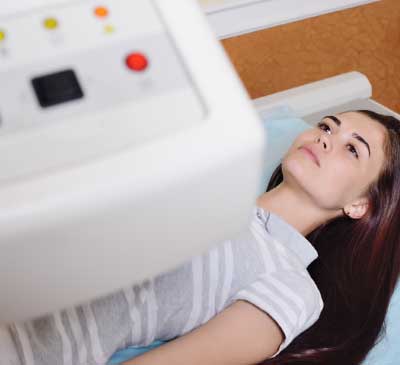
A DEXA scan at DEXA London takes approximately 15 minutes and involves minimal radiation exposure, less than a transatlantic flight. The scan covers the lumbar spine, femoral neck, and total body, giving you a complete picture of your skeletal health. Your results are reported by Dr Emil Gadimali and include a detailed breakdown of bone mineral density at each site, with T-scores and Z-scores for clinical interpretation.
Frequently Asked Questions
Can running cause low bone density?
Running is weight-bearing and generally supports bone health. However, very high mileage combined with low energy availability or hormonal disruption can lead to below-normal bone density, particularly at the lumbar spine. A DEXA scan can determine whether your running volume and nutrition are maintaining adequate skeletal health.
Is cycling bad for your bones?
Cycling does not directly damage bone, but because it is entirely non-weight-bearing, it does not stimulate the mechanical loading that bone needs to maintain density. Research shows that competitive cyclists have significantly lower bone density than runners and mixed-sport athletes. Adding resistance training and impact exercise can offset this risk.
How often should endurance athletes get a DEXA scan?
A baseline scan is recommended if you meet any of the risk criteria described above. If your results show normal bone density, a follow-up scan every two to three years is typically sufficient. If osteopenia or other concerns are identified, your clinician may recommend annual scans to monitor the response to intervention.
Can you reverse low bone density from endurance training?
In many cases, yes. Increasing energy availability, adding resistance and impact training, optimising calcium and vitamin D intake, and addressing any hormonal imbalances can lead to measurable improvements in bone mineral density over 12 to 24 months. Serial DEXA scans are the most reliable way to track progress.
Does swimming affect bone density?
Swimming is performed in a buoyant environment that removes gravitational loading from the skeleton. Systematic reviews have concluded that swimming does not produce positive effects on bone mineral density. Swimmers who want to protect their skeletal health should include weight-bearing and resistance activities in their weekly training programme.
What is RED-S and how does it affect bones?
RED-S (Relative Energy Deficiency in Sport) occurs when energy intake is too low to support both training and normal body functions. Bone health is one of the most affected systems: the body reduces bone formation and increases bone resorption to conserve energy. RED-S affects both male and female athletes and is diagnosed through a combination of clinical assessment, blood tests, and DEXA scanning.
Book Your DEXA Scan at DEXA London
If you are an endurance athlete who has never had your bone density checked, a DEXA scan is one of the most valuable health assessments you can book. At DEXA London, located at 86 Harley Street in central London, we offer clinical-grade DEXA scanning for bone density and full body composition analysis.
Your scan takes approximately 15 minutes and your results are reported by Dr Emil Gadimali. Whether you want a baseline measurement, need to investigate a stress fracture, or want to track your response to changes in training and nutrition, a DEXA scan gives you the precise, objective data that no other tool can provide.
To book your DEXA scan, call us on 0207 637 8227 or visit dexa-london.blowmedia.co.uk to learn more about our services.